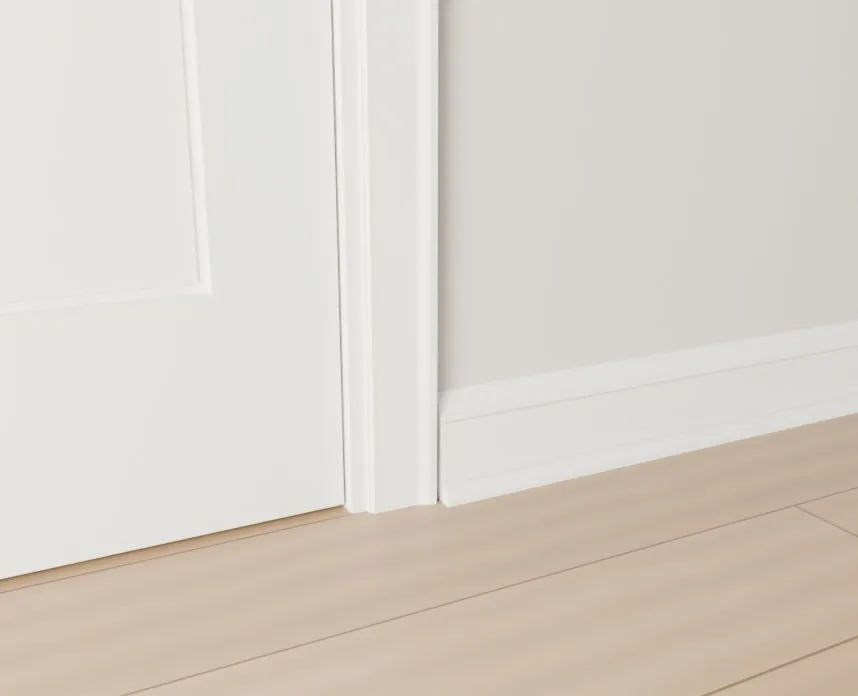
The short answer
MDF is stable, smooth and economical, so it suits long runs of baseboard and casing in dry rooms. Finger-jointed pine holds crisper edges and fasteners and copes better with knocks and damp, so it suits jambs, entries and wet areas. Both come factory primed for paint.
Side by side
| MDF | Finger-jointed pine | |
|---|---|---|
| What it is | Wood fibre pressed into board | Short lengths of clear pine joined end to end |
| Stability | Very stable; mitres stay tight | Stable for solid wood, but can move a little |
| Profile edges | Softer and easier to dent | Crisper and tougher |
| Water | Swells where an edge gets wet and isn’t sealed | Handles damp better |
| Paint surface | Smooth | Smooth, but finger joints can show through thin paint |
| Cutting | Fine dust; wear a mask | Normal wood dust |
| Cost | Lower | Higher |
A split that works in rental suites
- Jambs: finger-jointed pine. Jambs take the hinge screws and the knocks. Our prehung doors come in a 4-9/16″ finger-jointed pine jamb as standard.
- Casing and baseboard in dry rooms: MDF. Bedrooms, living rooms and hallways. It’s stable over long runs and costs less.
- Bathrooms, laundry and entries: pine, or well-sealed MDF. Mop water and boots reach the baseboard. If you use MDF here, seal every cut end and caulk the bottom edge.
Either way
- Store it flat and dry. Any trim stored wet can twist. See planning door delivery.
- Seal what you cut. Cut ends are bare. Prime them before the finish coats. See painting primed doors and trim.
- One white. We supply MDF and pine in the same factory primer, so a mixed order paints as one.
Sources
- Paint-grade trim: finger-jointed pine, poplar or MDF, Fine Homebuilding
- Trim materials, Premier Building Products
Code requirements change and local rules vary. Confirm sizes and clearances with your designer and building department before ordering. We supply doors, trim and hardware; we’re not a code consultant.